
The Complete Guide to Hybrid SEO Strategy
If you have noticed that your organic traffic is decreasing even while your rankings have not changed a lot, you are not alone. Something much more substantial is happening. The methods people use to search have changed fundamentally, and the conventional SEO method by itself is no longer sufficient. The answer is a hybrid SEO strategy that is built on the framework of Hybrid Engine Optimization (HEO).
This guide will take readers through what a hybrid SEO strategy is, why it’s better than traditional SEO on its own, and what you need to do to implement it on your site. Each step is explained in detail to make it easy for anyone to understand and implement it.
What Is a Hybrid SEO Strategy?
The mixed SEO strategy is a method that blends multiple strategies for search optimization into an integrated plan. Instead of focusing solely on Google results, we can optimize for all the places where users are looking for information, which includes AI tools such as ChatGPT, Perplexity, and Gemini.
By 2026, users can search using three primary methods:
1. You type in queries to Google or Bing and then click on the result.
2. Ask questions and receive straight responses via snippets of content and voice-based assistants.
3. They make use of AI programs such as ChatGPT as well as Perplexity and receive full answers without even visiting any websites.
A hybrid SEO strategy will ensure that your brand is visible in all three scenarios, not just one.
The official title for this strategy can be described as Hybrid Engine Optimization (HEO), a concept invented by Jori Ford during SEO Week 2025.
HEO connects three different optimization techniques: SEO, AEO, and GEO.
Why Traditional SEO Alone Is No Longer Enough
Before you get into the details of an integrated SEO strategy, it’s important to know why you require one first.
Click-through rates for organic search have decreased drastically. When Google displays an AI-generated answer in the uppermost position of the results, many users will take a look and then go away and do not click on any other website. The result is that the top ranking can be a bit less popular than it was in the past.
AI tools handle the hundreds of millions of search queries every day. ChatGPT alone has over 900 million active users per week in early 2026. Perplexity handles many millions of inquiries per month. A growing and significant portion of your customers is getting information from these platforms and not Google.
Zero-click search results have become the standard. The research suggests that approximately 65% of Google searches have ended without clicking. Users get the information they require directly from the page via AI-related overviews or featured content, as well as the knowledge panel.
However, here’s the good news. Visitors who visit your site from AI references are highly skilled. They have already read an answer that has mentioned your brand name, which implies they visit your site with a real purpose to convert at a greater rate than normal natural traffic.
The conclusion is obvious: you must be visible when your target potential customers are searching, and by 2026, this will include both Google and AI tools.
The Three Pillars of a Hybrid SEO Strategy
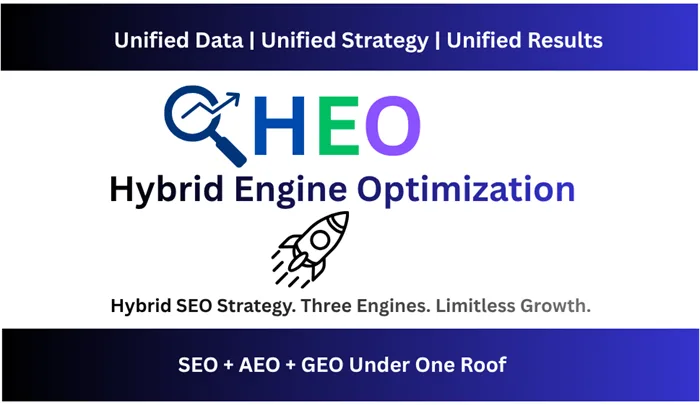
The hybrid SEO strategy is built around three essential elements that work in conjunction. Knowing each of them is crucial before combining them.
1. Pillar One SEO (Search Engine Optimization)
SEO is the basis. It’s about making your website appear for your site on Google and Bing by:
- Keyword search and on-page optimization
- Technical site health (fast loading, clean crawling, proper indexing)
- Backlinks from trusted, relevant websites
- Quality content that is compatible with the content that users are looking for
Without solid SEO fundamentals, the remaining two pillars of SEO will not function efficiently. Google rankings continue to influence the degree to which AI tools can trust and will cite your website’s content. If you’re not within the top 10 rankings for a particular topic, then your chances of being mentioned by AI tools related to that topic decrease dramatically.
2. Pillar Two AEO (Answer Engine Optimization)
AEO is focused on securing your content as the most direct answer to the search. These include Google’s featured search snippets. People Also Ask boxes, as well as voice search responses, along with AI Overview summaries.
The most important understanding for AEO lies in the fact that Google or AI tools aren’t just searching for websites. They’re seeking answers. Particularly, they are looking for short and clear solutions that are easy to pull up and provide users with without having users click.
AEO optimization means:
- Write a straight 2-to-4 sentence answer at the top of each section
- Using question-based headings corresponds to the way people use the internet to ask questions in real life.
- Add FAQ sections that have concise, clear responses
- Using the FAQ schema and other structured data markups so that search engines can recognize your responses
3. Pillar Three GEO (Generative Engine Optimization)
GEO is focused on ensuring that your brand is mentioned in AI-generated responses. If somebody is asking ChatGPT or Perplexity questions related to your industry, GEO is what helps your website be featured in the reply.
AI tools take their cues from the information available online. They use trusted sources to make their recommendations. Whether you are a digital marketing service provider or a business in any other industry, getting cited by AI platforms requires building a strong and trustworthy digital presence. To achieve this, you need:
- Brand authority through internet-wide citations, mentions, and links from reputable sources.
- Original data, research, and insights that AI tools cannot find anywhere else.
- Clear entity definitions so your brand, authors, and service descriptions remain consistent across the web. This consistency helps AI understand and confidently reference your business.
- Clean, well-structured information that AI crawlers can easily interpret and extract.
HEO integrates the three pillars of SEO into a single methodology. Instead of treating SEO, AEO, and GEO as separate initiatives, HEO combines them into a unified workflow, ensuring every piece of content is optimized for search engines, answer engines, and generative AI simultaneously.
How to Build a Hybrid SEO Strategy Step by Step
This is a simple step-by-step guideline for constructing an effective mixed SEO plan.
Step 1: Fix Your Technical Foundation
The hybrid SEO strategy is not a viable option for an unreliable website. Prior to anything else, make sure that the foundations are in place.
Conduct a thorough technical audit with a tool such as Screaming Frog, Ahrefs, or SEMrush. You should look for:
- Crawl error: Websites that Google or AI bots can’t access
- Slow page speed: aim for LCP (Largest Contentful Paint) under 2.5 seconds
- Mobile issues: most searches, including AI searches, happen on mobile
- Indexing issues: Pages that are supposed to be indexed but aren’t appearing in the index in Google search results.
One thing that most webmasters do not consider is checking their robots.txt file to see if it contains AI crawlers. AI tools like ChatGPT (GPTBot), Claude (ClaudeBot), and Perplexity (PerplexityBot) utilize their own crawlers to browse your website. A lot of websites block these bots. This means that the AI tools don’t look at your website content and therefore cannot use it as a source. Go to yourdomain.com/robots.txt right now and make sure these crawlers are not blocked.
Step 2: Build Topical Authority Around Your Core Subject
Google, as well as AI tools, provide websites with content that covers the subject in depth. A site with ten uninteresting blog posts on a subject is likely to be beaten out by a site with 30 interconnected, well-studied articles each time.
Create an HTML0 Content cluster for each major area you’d like to place in the top rankings based on:
- Create a lengthy, extensive webpage that provides the entire subject at a high-level.
- Make multiple related article which go into depth into the subject matter. Create multiple supporting articles that go deep on each subtopic.
- Connect them all so that crawlers, such as Google’s, as well as AI tools, can follow the connections and appreciate the depth of your subject matter.
This format signals to both search engines and AI tools that you’re an actual expert in the field and not merely someone who wrote an article.
Step 3: Rewrite Your Content HEO formatting
This is the most efficient action that most websites can take right away. Review the most important pages on your site and reformat them for the hybrid search.
This is what the HEO content format resembles:
Que: Headings written as a query (e.g., “What is the mixed SEO approach?”). Heading is written as a question (e.g., “What is
Ans: Answer directly 2 to 4 sentences that completely provide the answer (this can be the kind of thing that AI instruments and some of the featured examples from)
A detailed explanation of the HTML0 standard, with examples, and additional details (this will be meant for those who are looking for more information)
This format is effective because it offers AI tools a clear, self-contained answer that can extract information and quotes from, yet still delivers full value for humans who wish to know more about the subject.
Additional formatting rules:
- Limit paragraphs to 3 – 5 sentences max.
- Use lists with numbers and bullet points wherever they help make the information clearer.
- Beware of thick walls of text – both crawlers and readers skim them.
- Use everyday, simple language. Write like you’re explaining something to a knowledgeable friend.
Step 4: Establish Your Entity Presence
Traditional SEO focuses on keywords. A hybrid SEO strategy is focused on entities specifically defined in the real world, such as products, brands, people, and concepts.
Google, along with AI tools, comprehends the world around it through entities. If your company’s name isn’t well defined as an individual, AI tools may not be able to categorize your brand or recommend your brand.
How to establish the presence of an entity:
- Create a thorough “About” webpage with a clear message that defines who your brand is and what it is, and who’s behind it – in simple English.
- Design bio pages for authors with the author’s credentials, their areas of expertise, and hyperlinks to social profiles. Create author bio pages with credentials, areas of expertise, and links to social profiles.
- Use Organization schema and Person schema markups to officially declare these entities to search engines.
- Make sure your company’s name description, contact information, are identical across all your channels you go- the website you use, Google Business Profile, LinkedIn, social media, and any mentions by third-party sources of your brand.
Step 5: Add Schema Markup to Key Pages
Schema markup code provides Google and other AI tools with an organized, labelled knowledge of the content you publish. It is among the most effective and often underused tools that can be used as part of the hybrid SEO strategy.
Schema markups that a minimum of every website should include:
- The schema of an article for all blogs and guides informs AI tools that this is author content that was published with a date. The Article schema is used on all blog posts and guides.
- FAQ schema on pages that have questions and answer sections allows your Q&As to be directly accessible to Google or AI instruments and AI tools.
- An organization schema on your home page or about page is a way to define your brand as an actual entity. The Organization schema on your homepage or About page defines your brand as a real entity.
- Person schema on author pages establishes your authors as real, credible people.
- Breadcrumb List schema on all pages helps AI tools understand your site structure
Verify everything with Google’s Rich Results Test that your schema is functioning properly.
Step 6: Build Off-Site Brand Authority
Your website isn’t enough. AI tools can learn about your brand’s reputation across the web. Every mention in a blog, forum, podcast, or YouTube video on a social media platform increases your reputation in the eyes of your customers.
This is distinct from traditional link building. You are not just hunting backlinks. You are creating an image on the web that AI tools will be able to discover and believe in.
How to establish an off-site brand authority
- Contribute guest articles to respected publications in your industry.
- Be quoted for the authority resource in roundup articles and reports on industry trends.
- Help answer questions from Reddit, Quora, and LinkedIn in the capacity of an actual subject matter professional.
- Appear on podcasts relevant to your audience.
- Your brand will be featured in tool lists and guidebooks on resources.
To scale this process effectively and get high-quality positioning on trusted site tools, such as Link Booster, can assist. Link Booster connects you to real, relevant websites to help you get smart mentions and link placements, which is precisely the kind of signal that is authoritative and which both Google and AI tools depend on.
Step 7: Add an llms.txt File to Your Website
It is a brand-new technique that gives you a competitive advantage over websites that haven’t yet adopted it.
An llms.txt file sits at yourdomain.com/llms.txt and acts as a welcome note for AI language model crawlers. Like the way robots.txt directs the Google crawlers, llms.txt will inform AI tools the purpose of your website and which pages are the most crucial, and how to interpret your website’s content.
The format is straightforward, that is, a simple text file with a brief description of your website and hyperlinks to your most important pages. Although there is not all AI tools are officially compatible with this yet, incorporating it is easy and puts you in the lead.
Step 8: Track Hybrid SEO Performance
Old SEO metrics, such as the position of keywords and click-through rates are not paint the full picture. The hybrid SEO strategy requires a hybrid measurement.
Track these metrics alongside your traditional SEO data:
AI overview, appearance speed. How often does your content show up on Google’s summary of AI generated by the search engine? Tools such as Semrush, along with SE Ranking, now track this for terms.
Brands are mentioned in AI tool responses every week. You can access ChatGPT and Perplexity and ask questions about your area of expertise. Make note of whether your brand is mentioned in the responses. This is the easiest method to gauge GEO performance.
Branded Search Volume: With your authority growing, more people seek out your brand’s name directly. Keep track of this in Google Search Console. The steady growth of branded searches is a good indicator of your strategy’s hybrid, creating real recognition.
Referral traffic generated by AI instruments: When you open Google Analytics 4, check your referrer’s sources of traffic coming from chatgpt.com, perplexity.ai, and similar platforms. The traffic is increasing rapidly and converting at a rapid rate.
Engagement metrics include time on the page, scroll depth, time on page, and the number of pages per session. AI searchers are highly focused If they’re jumping around immediately, your website must be more effective in delivering promises made by the AI tool said it would deliver.
FAQs About Hybrid SEO Strategy
1. Does AI search tools render conventional SEO outdated?
No. SEO has always been the primary driver of online visibility. Hybrid SEO extends SEO to help companies appear not just in search results, but also on AI-generated solutions and suggestions.
2. Should I not invest in SEO in the event that I adopt HEO?
Not in any way. HEO is best when it is supported by solid SEO fundamentals. Quality of content, technical optimization, and authority signals are essential in both SEO and AI systems.
3. What’s the distinction between Generative Engine Optimization (GEO) and Answer Engine Optimization (AEO)?
GEO is focused on being referenced and cited by AI-generated replies, while AEO concentrates on gaining the search engines’ attention through formats like voice results and featured snippets. HEO is a combination of both strategies.
4. What are the expected results from an HEO-based plan?
Initial SEO improvements are often noticed in just a few weeks, but regular visibility of AI-generated answers typically requires a longer timeframe, usually between two and six months of ongoing optimization efforts.
5. What is the reason why AI visible take so much longer to implement than other SEO enhancements?
AI platforms require time to find how to process, analyze, and develop confidence in your content prior to using it regularly. This means that AI visibility is an investment that lasts longer in comparison to SEO enhancements.
6. Do small-scale businesses gain from HEO?
Yes. HEO isn’t just for big brands. All businesses are able to improve their chances of being featured in AI-generated responses by releasing authoritative, well-structured, and reliable content.
7. What’s the relationship with SEO, AEO, GEO, as well as HEO?
SEO assists in improving search rankings, AEO optimizes for answer-based results in search, GEO improves visibility in AI-generated responses, and HEO is the umbrella framework that ties all three of them together.
8. Does HEO have to be used only to AI tools such as ChatGPT?
Not at all. HEO is designed to work with the entire search ecosystem, which includes Google Search, AI Overviews Voice Assistants, answer engines, as well as dynamic AI platforms like ChatGPT, Perplexity, and similar tools.





About Author

Maulik
Co-Founder and Chief Growth Officer (CGO) | ADDACT As Chief Growth Officer at Addact, he drives business growth, digital transformation, and strategic innovation initiatives. With over 12 years of experience in technology consulting, digital experience platforms, and enterprise solutions, he helps organizations accelerate their digital journey through modern CMS, AI-powered experiences, and customer-centric growth strategies. His focus is on creating scalable business value, strengthening partnerships, and enabling long-term client success.